11 Ideas for Waldorf Educational Toys
The Misfit Teacher contains affiliate links which means that if you make a purchase using one of these links, I may receive compensation at no extra cost to you. Read my disclaimer for more information.
As a mom with a child in a Waldorf school, I am so inspired by the Waldorf philosophy and have adopted many of the practices at home – including Waldorf educational toys! Truthfully, I think it would be fine if all toys were Walforf toys. Kids naturally like them, they’re better for the planet, and they inspire kids’ natural imagination. They’re simple and timeless.

Waldorf toys are the kind of toy that make you say to your spouse, “Wow, I can’t believe how long he’s been playing with that.” They’re simple, but they really get kids to think, feel and connect. They are typically made with natural, eco-friendly materials, and very, very simple in design (which allows the child’s imagination to take it where the child wants.)
Waldorf toys are also said to promote calm and rhythm, and a connection to nature I’ll be honest – they are expensive, because of the quality of the materials, and not being mass-produced. But, they’re also better for the planet, great for kid’s natural imagination. (Not to mention, they look much nicer in a room than regular toys.) Here are some examples of Walforf toys that you can find (in person, or online) or, even make yourself.
Waldorf Educational Toys: Best Examples and Ideas
Tip: Waldorf toys tend not to tell the child ‘what to do’, or how to play. They are open-ended, and therefore imaginative. They also tend to be made with natural materials (you’ll see a lot of wood, felt, and cotton.)
1. The classic stacked rainbow
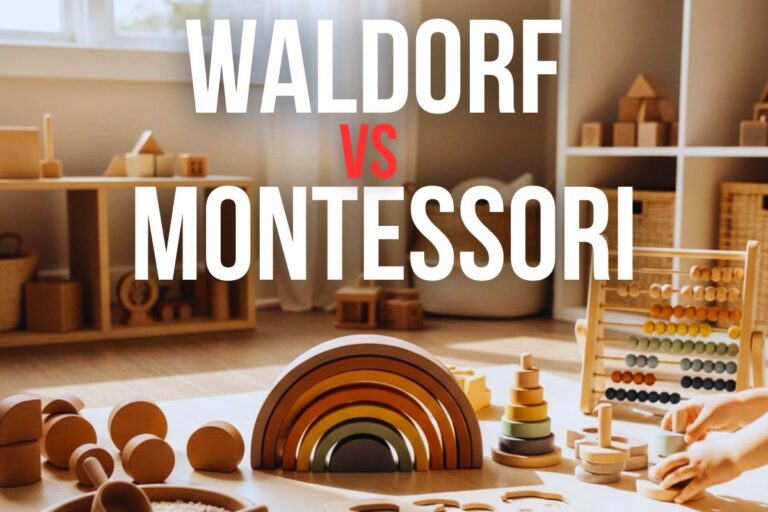
The stacked rainbow is a classic example of a Waldorf toy. The pieces of the rainbow come apart, so it doesn’t need to just be a rainbow. It can be many things to a kid invested in deep free play.

The rainbow looks pretty when its all stacked up, and it ‘pops’ nicely in a children’s room or play area. Then, they can take it apart and use it in all kinds of scenarios while they’re playing. Expect to spend anywhere from $50-$150 on a rainbow, which vary in size and colours. There are plenty of handmade ones on Etsy.
2. Waldorf dolls
The classic ‘Waldorf dolls’ tend to be made of a soft material, and they have very simple design and usually no expression on their face. The fewer details, expressions and other embellishments on the doll, the closer to Walforf it is.

This is because, more simple the doll is, the more that is left up to the imagination of the child playing and caring for it. (Which is the key to toys that fit with the Waldorf philosophy in general.) Waldorf soft toy dolls can come in the form of life-size baby dolls, or smaller figurine dolls. You can read more about the benefits of classic Walforf dolls here.
3. Wooden lacing/threading blocks
A set of wooden lacing and threading blocks of different colours (earthy and pastel tones) are a perfect example of a Walforf toy. These are classic Waldorf toys because kids can use and play with them in many different ways.

You can find these wooden threading toys in many places; Amazon, big box toy stores. There are many variations; make sure you’re choosing one that’s made of wood rather than plastic to be sure you’re choosing one that fits with Waldorf.
4. Ribbon wands
Ribbon wands are wands made out of wood, with ribbon sewed onto the end. They support imagination and also movement, as students can run around or spin while they watch the ribbon glide.

The ribbon should be made of silk, cotton or another 100% natural material (no polyester, which is made of plastic.) The stick part of the wand should also be made with a natural material. Ribbon wands can be a fun craft that kids can make at home or at a Walforf school.
5. Wooden animals
Wood-made animals are a great asset to a Walforf classroom or home. Similar to the dolls, they should be very minimalist in their design and expression, and of course made with fully wood or other natural materials!
Wooden forest animals or farm animals especially fit perfectly into a Waldof setting, but you can extend this to any kind of animal the child is interested in!
To be truly Waldorf-inspired, the animal should have no branding or character likeness. Slight imperfections, from being homemade (rather than mass-produced perfection), is a huge bonus too.
6. A minimalist, simple wooden ‘doll’ house
A dollhouse can be a Waldorf toy, as long as it meets some criteria:
- Being made with natural materials (wood), no plastic!
- Is designed in a way that is simple and open design (no fixed rooms, buttons, sounds, or branding)
- Uses neutral or very soft colours
- Comes with unfixed furniture (blocks instead of molded beds or sofas?)
The more minimalistic and unspecific the dollhouse is, the closer to being a Waldorf toy that it is.

The best Waldorf dollhouse may be a very simple one that you make yourself, or comes with no furniture at all so that kids can play with it in whatever way their imagination takes them.
7. A knitted animal
A knitted (or even felt or 100% cotton) animal is another classic example of a Waldorf toy. Yes, it’s simple – but that how Waldorf toys are meant to be. They feel warm and soft, which appeals to the child’s senses. They should ideally be expressionless, which leaves the thoughts and feelings of the animal to the child’s imagination!

Similar to the wooden animal idea, knitted animals should be very simple and not be bearing the likeness to any particular character or brand.
8. Leaf pocket dolls
Leaf pocket dolls are some of the cutest Waldorf toys I’ve seen. They are little felt people, that come with a felt leaf. Kids can take them in and out of the leaf. You can get ones with their eyes closed, or open.
These leaf pocket dolls inspire a connection to nature, as well as nurturing spirit and imagination. I know that they seem simple, but they’re very open-ended, which is the epitome of Waldorf toys!
9. Finger puppets
Finger puppets made of natural materials, with simple, non-branded designs, fit perfectly with Waldorf. To keep it Waldorf-inspiured, you want to stick to finger puppets that aren’t too cartoonish – are very minimal in their expressions, and designs.
10. A wooden abacus
A wooden abuscus is a bit closer to being a Montessori toy, but it is still Waldorf-inspired toy (especially with certain criteria.) Walforf toys tend to be more open-ended and less focused on a particular educational goal or skill (like math, counting), which is why a wooden abuscus fits quite a bit with Montessori.

However, if you get a wooden abuscus that’s made of wood and painted with earthy tones, then fits well with Walforf toys in a classroom or a child’s home.
In addition, don’t tell your child how to play with the wooden abacus. If you’re instructing them to count, learn times tables or any other goal, then it isn’t aligned with Waldorf education philosophy that focuses more on imaginative free play.
11. Beeswax candle-making kit
A Beeswax candle-making kit isn’t a ‘toy’ really – its a craft. However, making homemade candles it does fit perfectly with the Waldorf philosophy and education. I also found that enjoying the candles (under sufficient adult supervision, obviously) allowed for calming, Waldorf-inspired play.

I got this beeswax candle-making kit for my daughter as a Christmas present, knowing that it would be such a cozy activity and purposeful skill to learn how to make candles. Once the candles are made, you can also allow your child to use them as a toy rather than as a candle. They can use them however their imagination dictates, which is the epitome of Waldorf.
12. A knitting doll
My daughter played for so long with this knitting doll, which can be a Waldorf-inspired toy, depending on how you go about it. In our case, we didn’t require her to do any knitting or use the toy for any particular goal or purpose – which is the essence of Waldorf toys.

The key for Waldorf educational toys is to not make them too intentionally educational – the key is leave it up to the child’s imagination and interpretation. If they want to learn to knit with the knitting doll, then teach them. But its ok for the knitting doll to be used to make braids, or just be a doll – whatever the child chooses.
Final Thoughts
The key to Waldorf education is imaginative free play, and these kinds of toys have the flexibility to allow kids to do that. They’re simple, timeless, well-made (because of those natural, eco-friendly materials like wood) and often gender-neutral as well. These kinds of toys will do well in any household